In this article
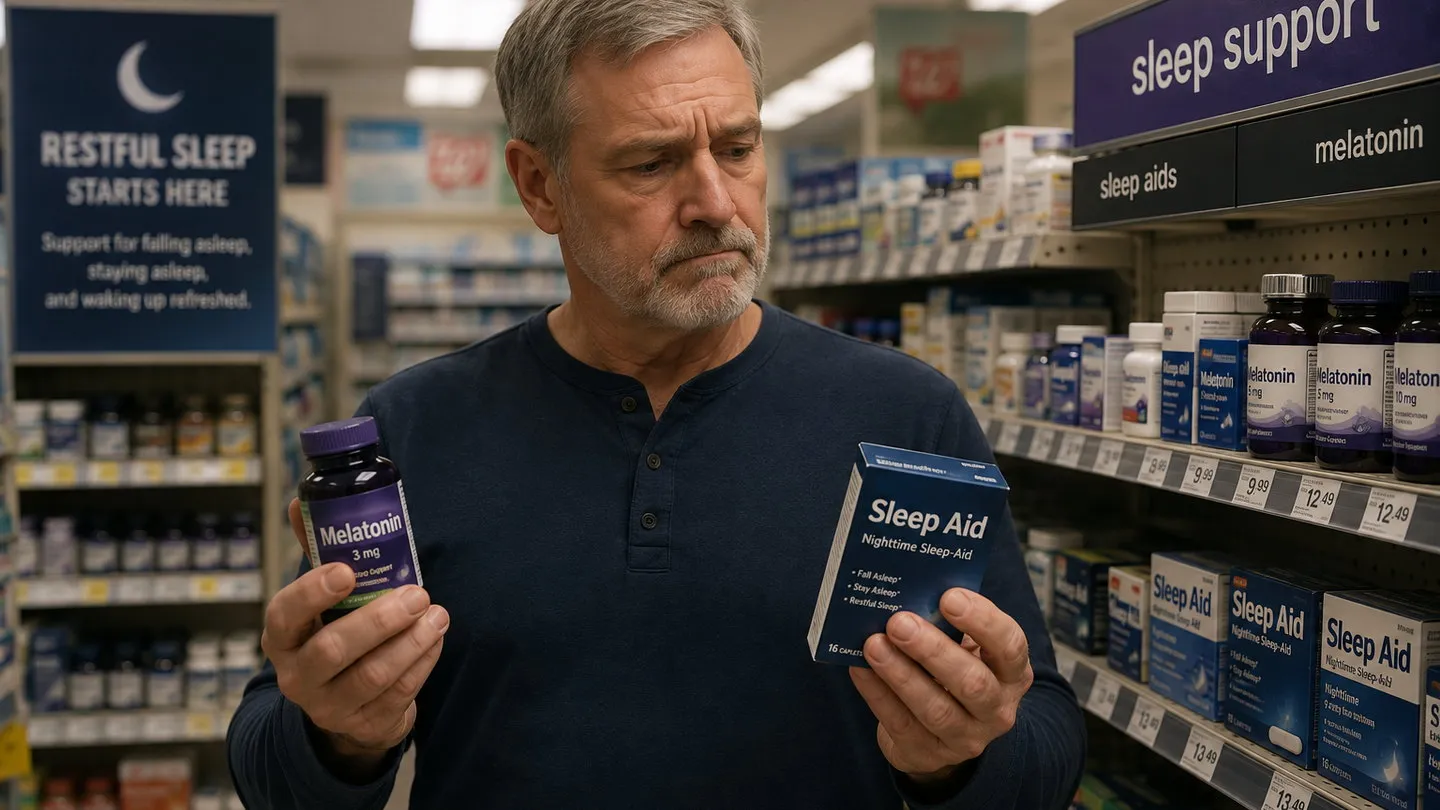
You know the problem now. The shelf still looks the same.
At this point you know something the sleep aisle rarely makes clear: falling asleep and staying asleep are different problems, and there’s no single hidden cause waiting to explain why you wake up when you do. That’s real, useful ground.
It doesn’t make the shelf any easier to read. Every option in the sleep aisle — a supplement, an app, a routine change, a program, a prescription someone mentioned — arrives sounding as if it can help. None of the labels tell you, on their own, which claim is actually worth trusting. That’s the real question from here: not “does this sound like it could work,” but “does this actually clear a real bar.”
The five questions that actually separate them
None of these require a medical background. They just require asking the question the label itself doesn’t answer for you.
- What problem is it actually aimed at? Onset, maintenance, circadian timing, or something else — the distinction you already know matters. A fix built for falling asleep faster doesn’t automatically help you stay asleep. If an option’s own claims don’t say which one it’s actually for, that’s not a small omission — it’s the first thing you can’t check.
- What level of evidence actually backs it — not just “studies show”? There’s a real difference between a professional guideline’s own strongest recommendation and a confident label with nothing specific behind it. Cognitive behavioral therapy for insomnia (CBT-I) carries sleep medicine’s own strongest recommendation grade for ongoing insomnia. Melatonin, by contrast, has a federal health resource stating plainly that there currently “isn’t enough strong evidence on the effectiveness or safety” of melatonin for chronic insomnia to recommend it that way — the stronger evidence it does have is for jet lag and a shifted schedule, a genuinely different problem than nightly staying-asleep waking.
- Is it aimed at something you’ve actually identified, or is it one more generic “better sleep” tactic? An earlier bedtime, cutting evening caffeine, a sound machine — these can genuinely help some people, and they’re not a waste of effort. But trying one after another, the same way you’d try any other, doesn’t tell you why the awakenings are happening. Neither does the next one you haven’t tried yet.
- What are the safety, dosing, and evaluation boundaries? Dietary supplements aren’t required to prove safety or effectiveness to the FDA before they’re sold — “natural” is not the same claim as “evaluated.” Melatonin specifically can stay active longer in an older adult’s body than a younger one’s, which can mean next-day grogginess at a dose that wouldn’t affect someone younger the same way. None of that means avoid it automatically — it means know it going in. And if what you’re dealing with is happening three or more nights a week for three months or longer, or coming with daytime fatigue that’s actually affecting you, that crosses into a conversation with a doctor, not a label to compare against another label.
- Does it actually match your own pattern, not a generic one? The honest check isn’t what the headline promises — it’s whether the claim corresponds to the specific staying-asleep pattern you have, not the version of “trouble sleeping” the label is written for. This one you don’t need a source for. You already know your own nights better than any label does.
What this actually gives you
Once you can run any option through those five questions, you’re not choosing between “the one with the most reviews” and “the one that was in stock.” You’re checking real, specific things against a bar you now know how to hold every option to — evidence tier, target problem, safety boundaries, and honest fit — instead of judging by which label sounds most confident. That’s not a small shift. It’s the difference between guessing and actually evaluating.
None of this means only one category of option can ever help, or that a supplement is automatically the wrong call and a clinical program is automatically the right one. It means the label alone was never going to tell you which is which — the five questions above are how you find out.
What’s still missing
Knowing the criteria is useful. The harder part is knowing which current option is actually worth putting through them — one aimed at the right problem, more transparent than a confident label, and different enough from what you’ve already tried to deserve a closer look.
Not all evidence answers the same question
Professional guideline
A recognized clinical body's own formal recommendation, based on reviewing many studies together -- e.g. a sleep-medicine guideline naming a specific first-line treatment.
Formula-specific evidence
A study on the exact, finished product being evaluated -- not just its ingredients tested separately.
Ingredient-level evidence
Research on one ingredient by itself. Real, and worth knowing -- but it doesn't automatically prove what a finished product containing that ingredient will do.
Vendor claim
What a product's own marketing says about itself. A claim, not evidence, until it's independently established.
These aren't interchangeable, and none of them cancels out the others -- a vendor claim doesn't inherit the authority of a clinical guideline just because both are words on the same page. A finished product needs its own evidence before a finished-product claim can be made about it.
Sources
What backs the claims in this piece — see our editorial standards for how we research and source every article.
- Melatonin: What You Need To Know
- Dietary Supplements: What You Need to Know
- Behavioral and psychological treatments for chronic insomnia disorder in adults: an American Academy of Sleep Medicine clinical practice guideline
- Clinical Practice Guideline for the Pharmacologic Treatment of Chronic Insomnia in Adults: An American Academy of Sleep Medicine Clinical Practice Guideline
- Combination treatment for chronic insomnia disorder in adults: an American Academy of Sleep Medicine clinical practice guideline
- Insomnia — Causes and Risk Factors
- Sleep Maintenance Insomnia