In this article
You didn’t imagine it
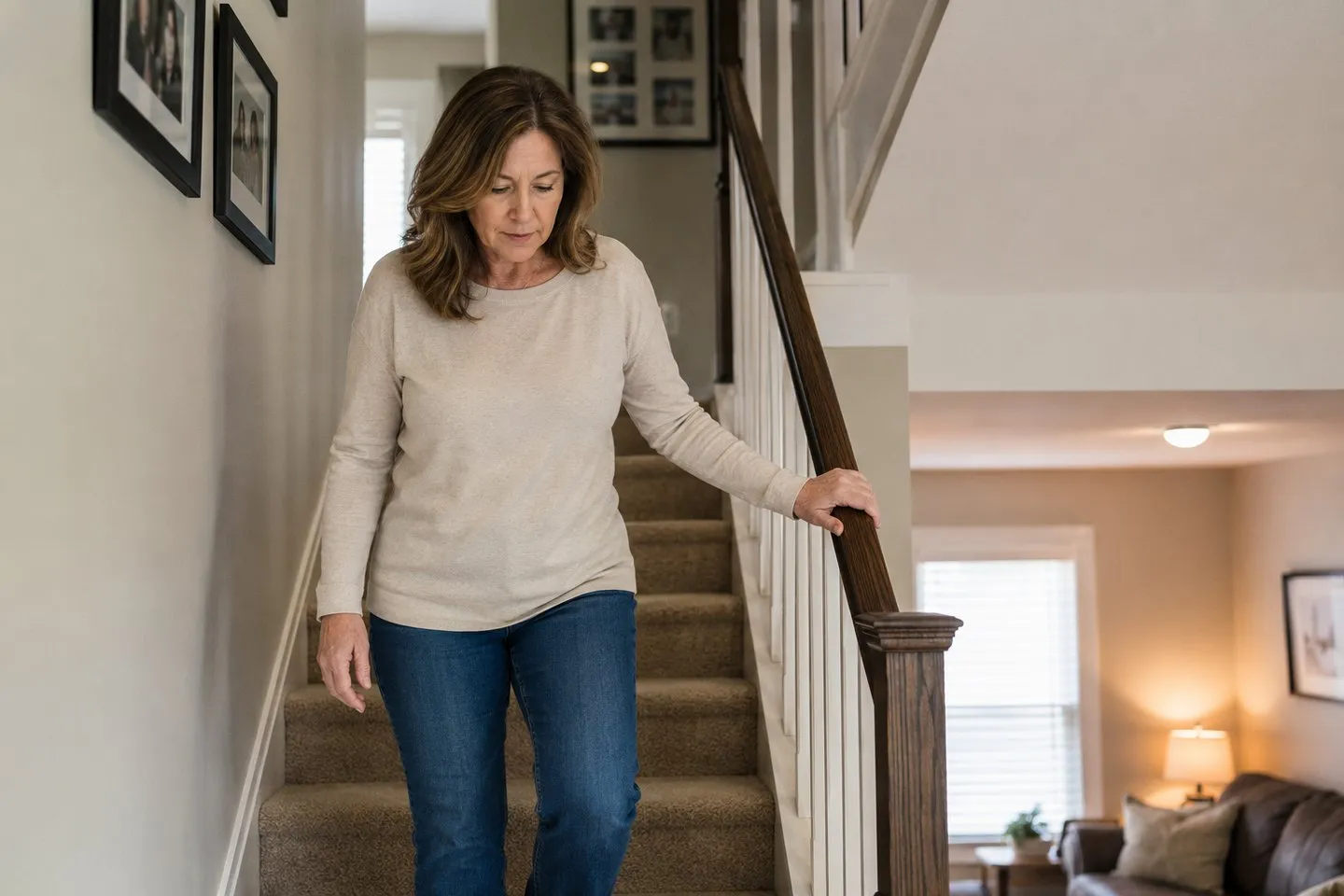
You used to take the stairs without a second thought. Now, somewhere along the way, you started gripping the railing — not because anything happened, just because it felt like the sensible thing to do. Or maybe it’s the groceries: you used to carry both bags in from the car in one trip, and lately you find yourself setting them down halfway to the door. Or it’s standing up from a low chair, or off the floor after gardening, and there’s a small pause where there didn’t used to be one.
None of that is an injury. None of it is a diagnosis. It’s a beat of extra effort in a task that used to ask for none — small enough to shrug off in the moment, and easy to second-guess afterward: was that really something, or am I imagining it?
You’re not imagining it. And it doesn’t mean what the two loudest stories about aging tell you it means.
The two stories, and why neither one fits
One story says this is an emergency — that the stairs and the grocery bags are early warning signs, and the only responsible move is to fight back hard, immediately, usually with something for sale. The other story shrugs: it’s just aging, nothing to be done, get used to it.
Neither one is accurate. What’s actually happening is more specific than either story allows, and more within your influence than the second one wants you to believe.
What’s actually changing
For most people, muscle mass and strength peak in their early thirties and then begin a slow decline. The research on this is specific: a loss of roughly 3 to 5 percent of muscle mass per decade after age 30, and that rate picks up further after 60. This pattern has a name — sarcopenia — and it’s exactly why a task that used to take zero effort now quietly asks for a little.
Here’s the part that matters most: this isn’t purely a function of the calendar. Inactivity is independently linked to speeding it up — closely enough that researchers have observed the same muscle changes seen in older adults show up relatively quickly in younger people who simply become inactive. That’s not proof that exercise reverses the clock; the same research is honest that government activity guidelines haven’t been rigorously shown to fix muscle health on their own. But it does mean the direction runs both ways: inactivity is one of the things that speeds this up, which means staying active is one of the real, concrete levers you actually have — not a guarantee, but not nothing either.
Balance is worth calling out on its own. It’s a separate skill from strength, and it’s the piece most consistently linked to a lower risk of falls — which is a large part of why the stair railing starts feeling like the sensible move. Working on it directly, not just generally “staying active,” is what actually addresses that specific noticing.
Ordinary versus worth a doctor’s visit
Most of what’s described above is ordinary: gradual, common, and not a red flag on its own. The distinction that actually matters isn’t whether you’ve noticed a change — most people your age have. It’s the shape of the change. Gradual and manageable, showing up as a bit more effort on tasks you can still fully do, tends to be ordinary. Sudden, severe, or a real new limitation on what you can do at all is the kind of thing worth raising with a doctor rather than working around alone. Nothing here replaces that conversation — see our medical disclaimer for how we think about that boundary.
What actually helps
The useful move isn’t a supplement, and it isn’t quietly working around the railing and the shorter grocery trips forever. It’s specific: strength work and balance work, together, aimed at the exact pattern described above — and it doesn’t require becoming “a gym person” to matter. We go deeper on exactly how to start, at whatever level you’re actually at right now, in a companion piece on strength training after 50.
Sources
What backs the claims in this piece — see our editorial standards for how we research and source every article.